
Thailand travel guide (2026)
Tropical beaches, temples and some of the best street food in Asia, in one country. Bangkok anchors it, with the mountain culture of Chiang Mai to the north and the Andaman coast at Phuket and Krabi to the south, each about an hour away by domestic flight. Costs are low enough that the same budget stretches much further.
Last checked September 2026
- Suggested length
- 4-6 nights recommended
- Budget guide
- About KRW 450,000-900,000 per person (excluding flights, 3-star hotel and local meals)
When to go
November to February is the dry, cooler season and the easiest window. March to May is the hot season, pushing towards 40C. June to October is the rainy season, with afternoon downpours — usually an hour or two rather than all day, and lodging is clearly cheaper. In the south the Andaman side (Phuket, Krabi) and the Gulf side (Samui) have opposite rainy seasons, so check by destination.
Getting between cities
Between cities, flying is the default. Bangkok to Chiang Mai or Phuket is a little over an hour on a low-cost carrier, and booked ahead it often costs less than the overnight train. The sleeper to Chiang Mai is the classic rail route: it saves a night's lodging and costs you about twelve hours. Within cities, ride-hailing apps like Grab and Bolt avoid the fare arguments that metered taxis and tuk-tuks invite.
What each region is for
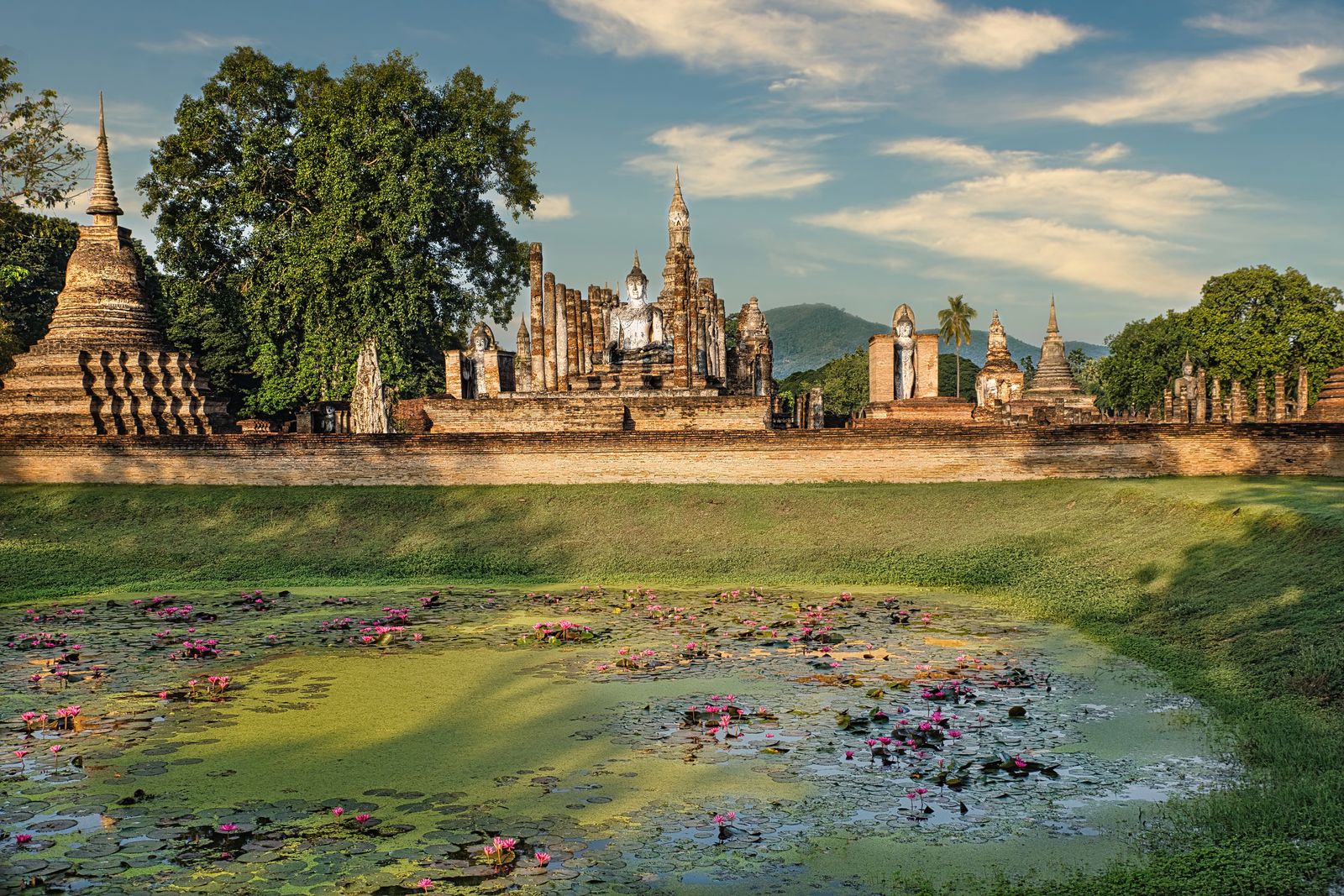
Bangkok's Grand Palace with Wat Pho and Wat Arun, the old walls and Doi Suthep at Chiang Mai, the ruins at Ayutthaya, and the limestone coast around Phuket and Krabi. Ayutthaya is ninety minutes by train from Bangkok and works as a day trip.
Food and eating culture
Pad thai and tom yum are only the entry point; the regions diverge. The north runs to noodle dishes like khao soi and milder heat, the northeast (Isaan) to som tam and sticky rice with strong fermented notes, and the south to coconut and heavier spice. Street stalls carry the cuisine, and a meal runs a couple of dollars.
Before you go
Is there something I must file online before arriving in Thailand?
Yes. Since 1 May 2025 every non-Thai national must submit the Thailand Digital Arrival Card (TDAC), whether or not they hold a visa. File it within three days of arrival at the official site, tdac.immigration.go.th; it is free. It replaced the paper TM.6 form, so older guidance describes a process that no longer exists. Paid lookalike sites are common — check the domain reads immigration.go.th.
Do I need a visa for Thailand?
Korean passport holders get 60 days visa-free, and many other nationalities get 60 days as well, though terms vary — check your own. Visa exemption does not remove the TDAC requirement above; they are separate. Immigration may ask to see an onward ticket and a hotel booking.
Between cities, fly or take the train?
Flying is the default for Bangkok to Chiang Mai or Phuket: a little over an hour on a low-cost carrier, and booked in advance often cheaper than the sleeper train. The overnight train to Chiang Mai is the classic rail journey — it saves a night's accommodation but costs around twelve hours. Short trip, fly; time to spare and an interest in the train itself, take the sleeper.
eSIM or physical SIM for Thailand?
An eSIM installed before departure is simplest, roughly USD 7-10 for five to seven days in 2026. Buying an AIS or TrueMove SIM in the arrivals hall at Suvarnabhumi or Don Mueang is equally common at a similar price. Since Grab needs data to work, arriving already connected is the smoother path.
How much cash do I need in Thailand? Are cards accepted?
Malls, hotels and chains take cards, but street stalls, markets and tuk-tuks are cash. Carry THB 3,000-5,000 per person. Rates at city money changers such as SuperRich beat the airport, and ATMs charge around THB 220 per withdrawal, so take out larger amounts less often.
Tuk-tuk or Grab for getting around?
Ride-hailing apps like Grab and Bolt are the low-friction choice: the destination and the price are set in the app, and you can pay by card. Tuk-tuks have no meter, so the fare has to be agreed before you get in and tourist pricing is common. Metered taxis sometimes need to be asked to run the meter. In central Bangkok, the BTS Skytrain and MRT are the reliable way to avoid traffic entirely.
Cities in Thailand
Pick a city and its sights, transit and costs sit on one page.
Thailand's capital, spreading along the Chao Phraya River. Golden palaces and temples blend with skyscrapers and rooftop bars, while street food and night markets keep the city humming late into the night. Famously affordable, it is Southeast Asia's great gateway and a top value-for-money destination.
Bangkok trip costItineraries covering Thailand
- Bangkok + Pattaya 5-Night, 7-Day Itinerary: Three City Days, Two Beach Days, and No Backtracking to Bangkok on Departure Day (Costs & Entry)
- Bangkok Thai Cooking Class Guide: From the Market Tour to Pad Thai, Bring Thai Cooking Home
- Bangkok 5-Day Itinerary: Grand Palace, Wat Pho, Khao San, Chatuchak, Siam, Asiatique (AI-Powered)