
Paris Travel Guide (2026)
The capital of art and romance, unfolding along the Seine. Iconic landmarks like the Eiffel Tower, the Louvre and Notre-Dame are scattered across the city, which is captivating enough just for its cafés and strolls through its lanes.
- Recommended stay
- 4–5 days recommended
💰 As of 2026, a 5-night Paris trip for two costs about US$3,890–US$8,350 in total, US$1,945–US$4,175 per person. 4-star hotel · 2 adults · 1 room. See full cost breakdown →

Food & dining
The heart of bistro and café culture. Famous for croissants and baguettes, escargot, steak-frites and desserts like macarons. Daily life revolves around neighborhood bakeries and sidewalk cafés.
Getting around
Connected to the city by RER trains and airport buses from Charles de Gaulle (CDG) and Orly (ORY). The dense Métro (subway) network makes getting around easy.
Highlights
Eiffel Tower, the Louvre, Notre-Dame Cathedral, Montmartre and Sacré-Cœur, Musée d'Orsay.
Places to visit

Croissant: Paris's best boulangeries
Flaky, buttery croissants from a city that crowns a best-boulangerie every year.

Macarons: Ladurée vs. Pierre Hermé
Paris's two great macaron houses: classic Ladurée and innovator Pierre Hermé.

Montparnasse Tower observation deck
A 210m, 59-floor tower whose deck frames the Eiffel Tower, Sacré-Cœur and Arc de Triomphe at once.
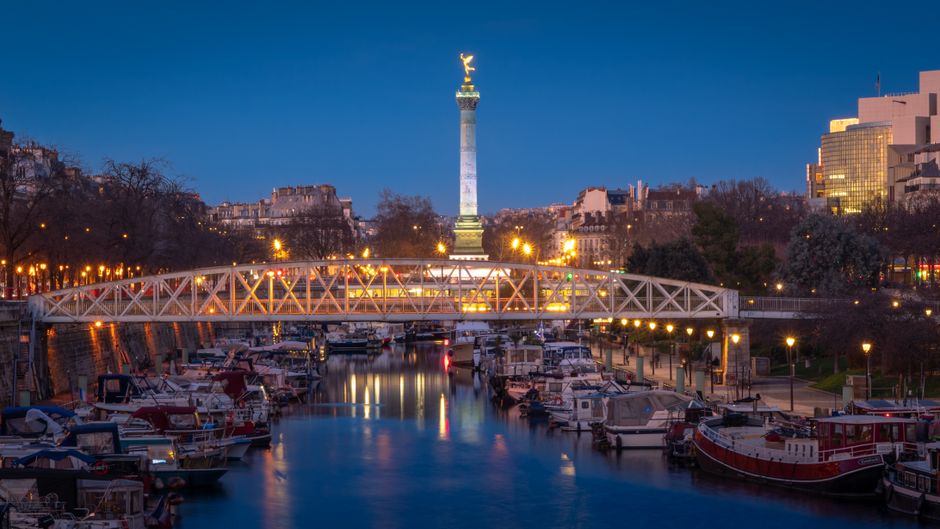
Seine dinner cruise
A three-course dinner cruise past the Eiffel Tower, Orsay and Notre-Dame.

Saint-Ouen Flea Market
Seven hectares, 1,700+ vendors, the world's largest antiques market at the end of Métro line 4.
Itineraries
Trip cost
2 adults · 1 room
Good to know before you go
When is the best time to visit Paris?
Paris is best in April-June and September-October, when the weather is mild and museum lines are shorter than in midsummer. July and August bring peak crowds and increasingly frequent heatwaves around 35C (95F), and many neighborhood restaurants and shops close for weeks in August for the French holidays, though major museums stay open. If you visit Paris in summer 2026, confirm your hotel has air conditioning, since many buildings still don't.
How do I get from CDG airport to central Paris in 2026?
The RER B train from CDG reaches Gare du Nord in central Paris in about 35 minutes and costs 14 EUR in 2026, the special airport fare, since regular metro tickets aren't valid on this stretch. Note that the Roissybus to Opera was permanently discontinued on March 1, 2026, so ignore older guides recommending it. Official taxis charge a flat 56 EUR to the Right Bank or 65 EUR to the Left Bank, luggage included.
How do Paris metro tickets work in 2026?
Since January 2026, a single Paris Metro/RER ticket costs 2.55 EUR and a bus/tram ticket 2.05 EUR, loaded onto a reusable 2 EUR Navigo Easy card or your phone, paper tickets are phased out across the network by June 2026. Metro and bus tickets are separate types with no free transfers between them, so buy the right one for your route. Trips to CDG and Orly airports require the separate 14 EUR airport ticket.
What's the best eSIM or SIM for Paris?
If your phone supports eSIM, install a plan before landing in Paris, Orange's Holiday Europe plan offers 30GB, 2 hours of calls, and 14 days of validity for 39.99 EUR in 2026, while budget apps like Airalo start under $10 for smaller data packs. EU roaming rules mean one plan covers side trips from Paris to other European countries. Physical SIMs are sold at Orange boutiques in central Paris, but expect queues.
Do US citizens need a visa or ETIAS for Paris in 2026?
US passport holders don't need a visa for France, Schengen rules allow visa-free stays of up to 90 days in any 180-day period. ETIAS, Europe's planned travel authorization, is still not in operation as of July 2026, its launch slipped past the original late-2026 target with no start date announced, so no pre-approval is needed yet. Since October 2025, the EU's Entry/Exit System (EES) registers fingerprints and a photo at the border, so allow extra time at CDG immigration.
Is Paris safe? How bad are pickpockets?
Violent crime against tourists is rare in Paris, but pickpocketing is genuinely common, hotspots include Metro Line 1, the RER B airport train, and the crowds around the Eiffel Tower, Louvre, and Montmartre. Keep bags zipped in front of you, don't leave phones on cafe tables, and walk past petition and bracelet approaches. Cards are accepted almost everywhere in Paris in 2026, so carrying minimal cash is both practical and safer.
More city guides
Plan this trip in Tripop
One sentence and AI builds your itinerary, checklist, and budget